Search This Blog

Friday, 3 February 2012

Lab 5b

Objectives-
  • Observe a variety of chemical experiments
  • Interpret and explain observations with the balanced equations
  • Classify each reaction as one of the four main types.
Supplies-
Equipment
  • Bunsen Burner
  • 6 test tubes
    • one will be flame heated
  • Test tube clamp\Medicine dropper
  • Wooden splint
  • Crucible tongs
  • Steel wool
  • Safety goggles
  • Lab apron
Chemical Reagents
  • Bare copper wire
  • Iron nail
  • 0.5M copper (II) sulfate solution
  • Solid copper (II) sulfate pentahydrate
  • 0.5M calcium chloride solution
  • 0.5M sodium carbonate solution
  • Mossy zinc
  • 2M hydrochloric acid solution
  • Hydrogen peroxide solution (6%)
  • Manganese (IV) oxide
Procedure-
  • Put on Lab apron and goggles
  • Make observations before, during and after.
Reaction 1
  • Adjust burner to high heat
  • Use crucible tongs to hold 6cm copper wire over hottest part of flame for a few minutes
Reaction 2
  • Clean iron nail with steel wool until shiny
  • Place nail in test tube. Add copper (II) sulfate solution until nail is half covered
  • After 15 minutes, remove and observe
Reaction 3
  • Put solid copper (II) sulfate pentahydrate in test tube until one third full
    • Test tube must be heat resistant
  • Heat test tube, gently angled away from self and classmates, slowing moving back and forth over the flame
  • Continue heating until no more changes occur
  • Save contents for reaction 4

Reaction 4
  • Allow test tube from reaction 3 to cool
  • Add 2-3 drops of water with medicine dropper
  • Record observations
Reaction 5
  • Fill a test tube one quarter full with calcium chloride solution. Fill a second test tube one quarter full with sodium carbonate solution
  • Pour calcium chloride solution into test tube containing sodium carbonate solution

Reaction 6
  • Put mossy zinc in test tube
  • Add hydrochloric acid until zinc is covered
Reaction 7

  • Fill half a test tube with hydrogen peroxide
  • Add a SMALL amount of manganese (IV) oxide
  • Test gas by placing a glowing splint into mouth of test tube
  • Wash hands with soap and water
Table 1-


Analysis of Results-
  1. Oxygen
  2. That a reaction occured betwen the Fe and the CuSO4
  3. In reaction 3, there was a change of color and consistency, and in reaction 4 there was an exothermic reaction
  4. Na2CO3 + CaCl2 -> 2NaCl + CaCO3 therefore calcium carbonate
  5. Use the glowing splint test to check for combustion

    1. It was oxygen
    2. H2O2 + MnO2 -> H20 + MnO2 + O2 therefore the liquid is H2O

Follow Up Questions-
  1. 1CdSO4 + 1Zn -> 1Cd + 1ZnSO4
  2. 2H2O ->2H2 + 1O2
    • Decomposition
Conclusion-
  1. 2Cu + O2 -> 2CuO     Synthesis
  2. 2Fe + 3CuSO4  -> Fe(SO4)3     Synthesis
  3. 1CuSO4 • 5H2O ->  1CuSO4 + 5H2O     Decomposition
  4. 1CuSO4 + 5H2O ->  1CuSO4 • 5H2O     Synthesis
  5. 1CaCl2 + 1Na2CO3 -> 1CaCO3 + 2NaCl     Double Replacement
  6. 1Zn + 2HCl ->1ZnCl2 +1H     Single Replacement
  7. H2O2 + MnO2 -> H2O + MnO2 + O2 (Will somehow figure this out later)

And, to continue our new tradition: The chemistry cat of the day

Wednesday, 1 February 2012

Endothermic and Exothermic reactions

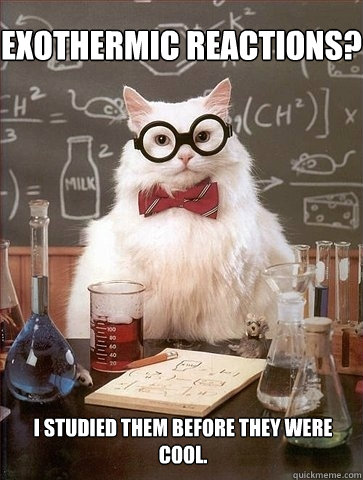
Today's Chemistry Cat!
Review

  • all chemical reactions involve a change in energy 
    • some absorb: indothermic endothermic
    • some release: exitthermic  exothermic
  • molecules are held together by chemical bonds
    • add energy to break bonds
    • give off energy to make bonds
reaction takes more energy to break then to make (bonds)= exothermic
reactions takes less to break then make (bonds) = 
endothermic

Endothermic and Exothermic Reactions
Entropy: heat contained in a system 

Energy Diagrams
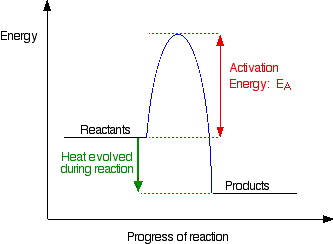
  • we can graph potential energy of chemicals as they under go a reaction
  • relative amounts of energy determine if a reaction is endothermic or exothermic
Activated Complex: potential energy of the transition state between reactants and products
Activation Energy: energy that must be added to make the reaction to occur
DeltaH (change in entropy): change in potential energy during reaction (products - reactants)

Endothermic Energy Diagrams

  • products will have more energy then the reactants (deltaH will be positive)
Exothermic Energy Diagrams
  • products will have less energy then the reactants (deltaH will be negative


Try these!
exothermic vs endothermic quiz

this has the same ideas as above  
The first 6 questions are just looking at the graph and saying the answer. 
The last 6 questions are as if the graph is flipped...the graph now starts at what you before considered the end and goes TOWARD the y-axis.  Good luck :)

Friday, 20 January 2012

Types of Reactions (continued)

Double Replacement
A reaction that occurs between 2 ionic compounds.
Usually happens in solution
The positive ions (cation) switch places

Formula:
 
e.g. 1 Na2CO3 + 1 CaCl2 --> 1 Ca CO3 + 2 NaCl

If there is a change in state, there is a reaction.
If there isn't a change in state, there is no reaction.

Use the "Table of solubilities" to determine states:

  1. Find the anion in the left hand column
  2. Look for cation in the 2nd column
  3. Follow its presence or absence to the word "soluble" or "not soluble"
  4. If soluble, the compound is aqueous (aq); If insoluble, the compound is solid (s)
There is a NET reaction when precipitation occurs
The aqueous ions that are the same on both sides get cancelled

Example:
For double replacement reactions (including neutralization), some ions participate in the reaction while others does not 

Combustion
A reaction that involves burning air

Formula:

AB + O2 --> AO + BO
Example:


Neutralization
A special double replacement reaction where acids react with bases to produce water and ionic salt
Acids have an H as the cation; bases have OH as the anion
Both should be aqueous

Formula:

HA + BOH --> H2O + BA
Example:


Recap:


The 6 types of chemical reactions include:

  1. Synthesis
  2. Decomposition
  3. Single replacement
  4. Double replacement
  5. Combustion
  6. Neutralization

Wednesday, 18 January 2012

Types of Reactions

Synthesis
A reaction that combines 2 or more reactants to form a product
Formula:


Ex. 2 Ag + S  Ag2S
      4 Fe + 3 O2  2 Fe2O3


Decomposition
A reaction that breaks down one reactant into 2 or more products
Formula:


Ex. 2 KClO3  2 KCl + 3 O2
Single Replacement (Displacement)
A reaction when one element replaces an ion in an ionic compound. Metal elements replace positive ions and non-metal elements replace negative ions.
Formula:
A + BC --> AC + B           (A = metal)
A + BC --> BA + C           (A = non-metal)
Ex. 2 AgNO3 + Cu  Cu(NO3)2 + 2 Ag
      2 KI + Cl2  2 KCl + I2


The element doing the replacing has to be higher on the Activity Series Chart than the one being replaced to have a reaction!!!!


PRACTICE:
Balance the equation and state what reaction it is.

N2 + H2 --> NH3 
C + Fe2O3 --> Fe + CO
NH4I + Cl2 --> NH4Cl + I2
Al + H2SO4 --> Al2(SO4)3 + H2
Au + HCl -->  ?
H2O ---> ?
NaI + F2 ---> ?

Monday, 16 January 2012

Balancing and naming equations

Naming formulas
We know its been a while but here is a small review for naming those formulas.
ionic compounds...
They are always metal and a non-metal.
Ex. NaCl
      Na as a charge of +1
      Cl has a charge of -1
The cross over method is quite effective
      Na1Cl1
     Now reduce
      NaCl

Ex. Fe2O3
      Iron is a multivalent compound (Fe can either combine as 2+ or 3+)
      Uncross the the subscripts
      Fe^3
      O^2
      We know oxygen has a charge of -2 (so 2 and 3 are not reduced numbers) so we are using the charge 3+
      Iron oxide
      However, we need to specify which form of iron we are using; for that, we must use roman numerals.
      So it would be named: Iron (III) oxide.

covalent formulas....
Theses are quite easy to name as you literally name as you see it.  However, because the people who chose how these formulas should be named wanted to make our lives difficult, they used Greek.


Ex. CO2
  That is simply telling you that the compound has 1 carbon 2 oxygen.

So to name it, you would write
                           monocarbon dioxide.
HOWEVER, just to confuse you more.  There is a general rule.  You are never to use mono on the first element (even if it has only one atom).  You only use mono if
the second element has 1 (for ex. CO = Carbon monoxide)

So CO2 would be written as Carbon dioxide.


Balancing Equations


Here is a basic tutorial on how to balance equations
Here is a fill in the blanks sheet to practice balancing of equations.  At the end, check your answers!

Sunday, 8 January 2012

The Molar Volume of gas at STP

(Standard Temperature and Pressure)
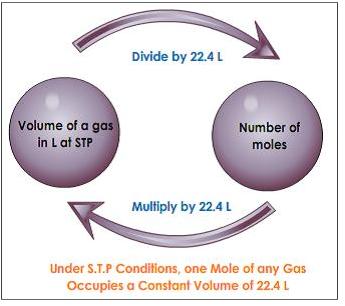
Gases change volume (either get bigger or smaller) when there is a change in either temperature or pressure. The standard temperature and pressure that is used to compare different gasses is called STP.
1 STP is equal to 1 atmosphere of pressure and is at a temperature of 0ºC, which is the equivalent to 273.15ºK or 32ºF.
It is also known that at STP on mole of any gas takes up 22.4L of space.
                                     
Example:
Calculate the volume occupied by 8.10g of O2 at STP.
STEP 1: calculate molar mass of O2.
O=16 x 2 = 32g/mol.
STEP 2: find # of moles.
8.10g O2 x 1mole = 0.253125 moles
                     32g   
STEP 3: find the molar volume given that 1 mole of gas is equal 22.4L.
0.253125 moles x 22.4L = 5.67L
                                   1mole
                                                8.10g of O2 at STP = 5.67L of O2.

Wednesday, 4 January 2012

Diluting Solutions to Prepare Workable Solutions

Introduction

Chemicals are shipped around the world in their most concentrated forms (solids, concentrated acids, etc.)
If this is not the case, we'd be shipping lots of water along with the chemicals; and this results less cost effective.  Therefore, we need to be able to make solutions of any concentration from a more concentrated source.


Key Idea
  • Moles of solute is constant (i.e. the only difference is that there's more water in the less concentrated solution)

Formula


moles solute before = moles solute after

M1L1 = M2L2

M = molarity
L = volume
1 = before
2 = after

Sample Question

Concentrated NaCl is 10 mole/L.  How to make up 2.0 L of 3.0 mole/L?

Step one: decide what which variable we need to find out

M1 = 10 mol/L
M2 = 3.0 mol/L
L1 = ?
L2 = 2.0 L

We need to find L1.

Step two: write down the formula and plug the already known variables in the formula

M1L1 = M2L2
10 mol/L * L1 = 3.0 mole/L * 2.0 L

Step three: solve for the unknown variable

L1 = 3.0 * 2.0 / 10
L1 = 0.60 L

Step four: find out the amount of water needed by subtraction

2.0 L - 0.60 L = 1.4 L of water

Therefore, we need 0.60 L of NaCl and 1.4 L of water to make up 2.0 L of the solution.

Things to keep in mind...
  • Watch out for significant figures when solving the questions.
  • Note that: solute = chemical in smaller quantity, solvent = chemical in larger quantity

Links for your reference

http://dl.clackamas.cc.or.us/ch105-05/dilution.htm (this is a site with detailed examples and explanations of how to solve dilution problems)

http://www.800mainstreet.com/9/0009-008-dilution.html (a site with examples of dilution problems in various forms)

http://www.graphpad.com/quickcalcs/molarityform.cfm (molarity calculator.  Use it to check your answer)