Search This Blog

Monday, 23 April 2012

History of the Periodic Table

Since the 5th century, a few elements had been discovered, including gold, tin, silver, lead and mercury, as these were easy to find. The first discovery was by Henning Brand, a German man, on a wild chase for the philosophers stone. In 1669, he discovered phosphorus, but kept it a secret, and the rock was later publicized in 1680 by Robert Boyle.
A hundred years later, a chemist named Antoine Lavoisier lived. He created a text book of elements that could not be broken down, which also included light, and caloric, which were then believed to be material substances.
Lavoisier's elements

Gases
New names (French)
Old names (English translation)
Lumière
Light
Calorique
Heat
Principle of heat
Igneous fluid
Fire
Matter of fire and of heat
Oxygène
Dephlogisticated air
Empyreal air
Vital air
Base of vital air
Azote
Phlogisticated gas
Mephitis
Base of mephitis
Hydrogène
Inflammable air or gas
Base of inflammable air
Metals
New names (French)
Old names (English translation)
Antimoine
Antimony
Argent
Silver
Arsenic
Arsenic
Bismuth
Bismuth
Cobolt
Cobalt
Cuivre
Copper
Étain
Tin
Fer
Iron
Manganèse
Manganese
Mercure
Mercury
Molybdène
Molybdena
Nickel
Nickel
Or
Gold
Platine
Platina
Plomb
Lead
Tungstène
Tungsten
Zinc
Zinc
Nonmetals
New names (French)
Old names (English translation)
Soufre
Sulphur
Phosphore
Phosphorus
Carbone
Pure charcoal
Radical muriatique
Unknown
Radical fluorique
Unknown
Radical boracique
Unknown
Earths
New names (French)
Old names (English translation)
Chaux
Chalk, calcareous earth
Magnésie
Magnesia, base of Epsom salt
Baryte
Barote, or heavy earth
Alumine
Clay, earth of alum, base of alum
Silice
Siliceous earth, vitrifiable earth
 By 1809, 47 elements had been discovered. Chemists noted pattern in reactions, and attempted to classify them. 
In 1862, the first form of element organization is published by a French chemist, Alexandre-Émile Béguyer de Chancourtois, that appeared to be a spiral, with increasing mass downward.

1864 John Newland proposes the Law of Octaves, which he found by assigning a mass of 1 to helium, and then ordering the rest by mass. This lead to the discovery that every 8th element had similar properties, 
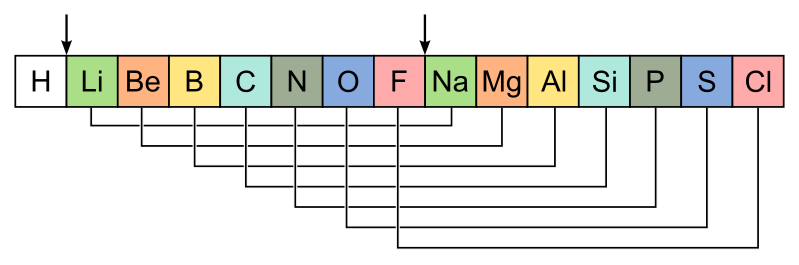
File:PTE-Law of Octaves.svg
in 1869, Mendeleev published the first official periodic table. He ignored certain previous ideas, and instead grouped certain elements together according to properties, vs the previous method of weight organization. Mendeleev predicted atomic weights of yet to be discovered elements, and left empty sections in his table to accommodate them
In 1911, Ernest Rutherford publishes a paper that explained nuclear charges. Later that year, Antonius Van Den Broek publishes a paper relating the atomic weight of an element to the charge of the atom. This became the basis of organization of the table, the atomic number.
Two years later, Henry Moseley proposes that the wavelengths of x-ray emissions of elements is directly proportional to that of the atomic number.
The latest changes made were by Glen Seaborg, who discovered plutonium, and elements 94-102. It was his doing that resulted in the lanthanide and actanide series' being placed below the table.

Saturday, 21 April 2012

Periodic Table Trends

The periodic table is not organized randomly, it follows certain trends.
There are some trends we need to know.

Here is a youtube video that pretty much covers EVERY trends we need to know.


Below are the trends summarized in point form :D

1) Metallic properties

  • From left to right across the table, the elements change from metal to non-metal
  • From top to bottom down the table, elements become more metallic, or better metals
2) Atomic radius

  • From left to right across a row, the radius of atom decreases because increase in number of protons brings the electrons closer to the nucleus
  • From top to bottom down a group, the radius increases
3) Atomic size

  • From left to right across a period, the size decreases
  • From top to bottom down a group, the size increases
4) Reactivity

  • For metal:
    • From top to bottom down a group, the elements become more reactive
    • in transitional metals, the middle part of the table is the least reactive and to the left or to the right become more reactive
    • the most reactive metal is Francium
  • For non-metal (excluding noble gas):
    • From top to bottom down a group, the elements become less reactive
5) Ion charge
  • Metals tend to have positive charges
  • Non-metals tend to have negative charges
  • the transitional metals have variable charge
6) Melting & boiling point
  • elements in the centre of the table have the highest melting and boiling point
  • Noble gases have the lowest M & B point
  • from left to the right across the table, the M & B point increases until the middle of the table
7) Ionization energy
  • this is the energy required to completely remove an electron from an atom
  • From bottom to up, left to right cross the table, the energy increases
  • All noble gases have high ionization energy
  • Helium has the highest ionization energy while Francium has the lowest
  • Note: this trend is opposite from atomic radius trend
8) Electronegativity
  • Electronegativity is basically how much atoms want to gain electrons
  • Note: this trend is the same as the trend for ionization energy
  • Noble gases are excluded from the trend as they already have full shells (so they don't want to gain or loss electrons)

Thursday, 12 April 2012

Writing Electronic Configurations

Neutral Ions

-always start with the lowest level first (Aufbau Principle)
-Figure out how many electrons you have (Neutral atom = Atomic #)
-start with the lowest energy level (1s) and keep adding until you have no electrons left
-Each electron has an opposite spin designated 
Ex. Sillicon: 14 electrons
2 electrons in 1s, 2 electrons in 2s, 6 electrons in 2p, 2 electrons in 3s, 2 electrons in 3p
A-E shows the steps taken to write the electron configuration
The 2 electrons in the 3p subshell aren't paired because of Hund's rule: when electrons occupy orbitals of the same energy, they can't be paired up until they have to.
written as: 1s22s22p63s23p2

Ions
negative charged ions: add electrons to the original number of electrons according to its charge
ex. P3- : 15+3
15 being its original # of electrons and 3 added because of its charge
total electrons = 18
written as: 1s22s22p63s23p3
positive charged ions: remove electrons from its original number of electrons according to its charge
ex. Ba2+: 56-2
total electrons: 54
written as: 1s22s22p63s23p64s23d104p65s24d105p6

Core Notation
-set of electrons that can be divided into two subsets: core electrons and outer electrons
core: set of electrons with the configuration of the nearest noble gas that comes before it
outer: consists of all electrons outside the core (normally takes part in chemical reactions)
ex. Ca
1)the noble gas before calcium is Argon, so you put argon in square brackets
[Ar]
2)then add the remaining electrons
[Ar]4s2

2 EXCEPTIONS: Copper (Cu) and Chromium (Cr)
Cu:  [Ar]4s3d­10
Cr: [Ar]4s3d5

Tuesday, 10 April 2012

Electronic Structure of the Atom

-the electronic figuration of an atom is a notation that describes the orbits in which the electrons occupy and the total number of electrons in each orbital
ex. Manganese's electron configuration: 1s22s22p63s23p64s23d5


energy level: the amount of energy which an electron in an atom can posses (n)
quantum of energy: energy difference between 2 particular energy levels
ground state: when all the electrons of an atom are in their lowest possible energy levels
excited state: when one or more of an atom's electrons are in energy levels other than the lowest available level
orbital: the actual region of space occupied by an electron in a particular energy level
shell: the set of all orbitals having the same n-value
subshell: set of orbitals of the same type

Specific types of orbitals are possible for a given value of "n":
n=1 : s-type ONLY
n=2: s- and p-types
n=3: s-, p- and d-types
n=4: s-, p-, d- and f-types
Pauli Exclusion Principle: A maximum of 2 electrons can be placed in each orbit

S-type subshell: ONE s-orbital and 2 max # of electrons

P-type subshell: THREE p-orbitals and 6 max # of electrons
D-type subshell: FIVE d-orbitals and 10 max # of electrons
F-type subshell: SEVEN f-orbitals and 14 max # of electrons

Wednesday, 4 April 2012

Valence Electrons

- valence electrons are all electrons EXCEPT those in the core or in the filled d- or f- subshells

Valence Electrons: in the outermost (energy level) open electron shell of an atom
Open Shell: contains less than its maximum number of electrons
Closed Shell: exactly its maximum number of electrons

ex. Br:  [Ar]4s23d104p5  =  7 valence electrons
Ca: [Ar]4s2  =  2 valence electrons

Xe: [Xe]  =  8 valence electrons

Monday, 2 April 2012

Atoms, Ions and Isotopes

Review


Properties of sub-particles

  • neutral atom has no overall net charge
  • number of protons = number of electrons

The atomic Number (number of protons)

  • protons found in nucleus
  • IF no electric charge
    • atomic number=number or protons=number of electrons
  • if a proton is added to an elements nucleus, a new element will be produced

Ions

  • most atoms can gain or loose electrons
  • few elements (ex. hydrogen) can gain or loose both
  • atoms that gain or loose electrons care called Ions
    • ion is an electricity charge atom
    • negatively charged normally non-metal
    • positively charge tend to be metals

Mass Number

Mass number:  total number of protons and neutrons or atomic mass number
  • number of neutrons= mass number-atomic number  OR atomic mass - atomic number
  • atomic number(pro.)= mass number-electrons
  • atomic mass=average of all isotopes
    • mass number= round number of atomic mass
  • MASS NUMBER DOES NOT EQUAL ATOMIC MASS

Isotopes

  • neutron is added to an elements nucleus which makes a heavier version of the same element
    • same element with bigger atomic mass
    • same number of protons and electrons
      • different number of neutrons so different atomic mass
For example, if you had Calcium-41, how many neutrons would there be?

Calcium-41 = Calcium with an atomic mass of 41
Calcium       = atomic number is 20 (20 protons)
                       atomic mass= protons + neutrons
                    = n + 20 = 41
                       so there are 21 neutrons
                             there is no charge listed so assume 
                                 number of electrons= number of protons
                                 Your done :)

NOW HERE IS A VIDEO THAT CONTAINS EVERYTHING YOU NEED TO KNOW! 


Thursday, 8 March 2012

Lab 6D

Experiment 6D--Determining the Limiting Reactant and % Yield in a Precipitation Reaction

Objectives-
  • To observe the reaction between solutions of sodium carbonate and calcium chloride
  • To determine which of the reactant is the limitng and which is the excess reactant
  • To determine the theoretical mass of precipitate that should form
  • To compare the actual mass with the theoretical mass of precipitate and calculate the percent yield
Supplies-


Equipment
  • centigram balance
  • two 25mL graduated cylinder
  • beacker (250mL)
  • wash bottle
  • safety goggle
  • filtering apparatus
  • ring stand
  • 250 mL funnel
  • filter paper
  • lab apron
  • safety goggles
By the way, the filtering apparatus should be set up like this.


Chemical Reagents
  • 25 mL of 0.70 M sodium carbonate solution
  • 25 mL of 0.50 M calcium chloride solution
Procedure:

Day1:


  1. Put on lab coat and goggles
  2. Obtain two 25 mL graduated cylinder and a 250 mL beaker
  3. Measure 25 mL of sodium carbonate and calcium chloride solution.
  4. Pour them each into the 25mL graduated cylinder.
  5. Combine the two chemicals by pouring them both into the 250 mL beaker. Wait for 5 minutes while observing what happens.  Record the observations.
  6. Write your names on the filter paper and then weigh the filter paper. Set up the filtering apparatus while waiting
  7. Use a wash bottle to wet the bottom of the filter paper to keep it in place
  8. Stir the newly mixed chemical into the filter as it filters the liquid into the beaker. Wait for the filtering to be completed.
  9. Once all filtered, take the filter paper our and place it on a paper towel to dry.
  10. Remember to clean up and wash your hands once you are done on day one of the experiment.
Day 2:


  1. Weigh and record the precipitation from the chemicals from day 1.


Conclusion:
To find the results of the lab, we did the following calculations:
  1. Measured the amount of CaCO3 produced by our experiment in grams with a centigram.
  2. Balance the equation 1Na2CO3 + 1CaCl2 ---> 2NaCl + 1CaCO3
  3. Calculate the theoretical yield using stoichiometry
  4. Calculated the percent yield for the experiment
  5. % yield = experimental result / theoretical yield * 100%
So, the result depends on the experimental outcome (the mass of the precipitation).  Therefore, each group will get slightly different answer.  However, the overall result should be approximately 90-95%.